
Plant Today, Enjoy for Generations: A Louisiana Homeowner’s Guide to Choosing and Caring for Native Trees7-minute readFew features of a Louisiana property can make as dramatic a difference as

Dated: September 14 2026
Views: 35
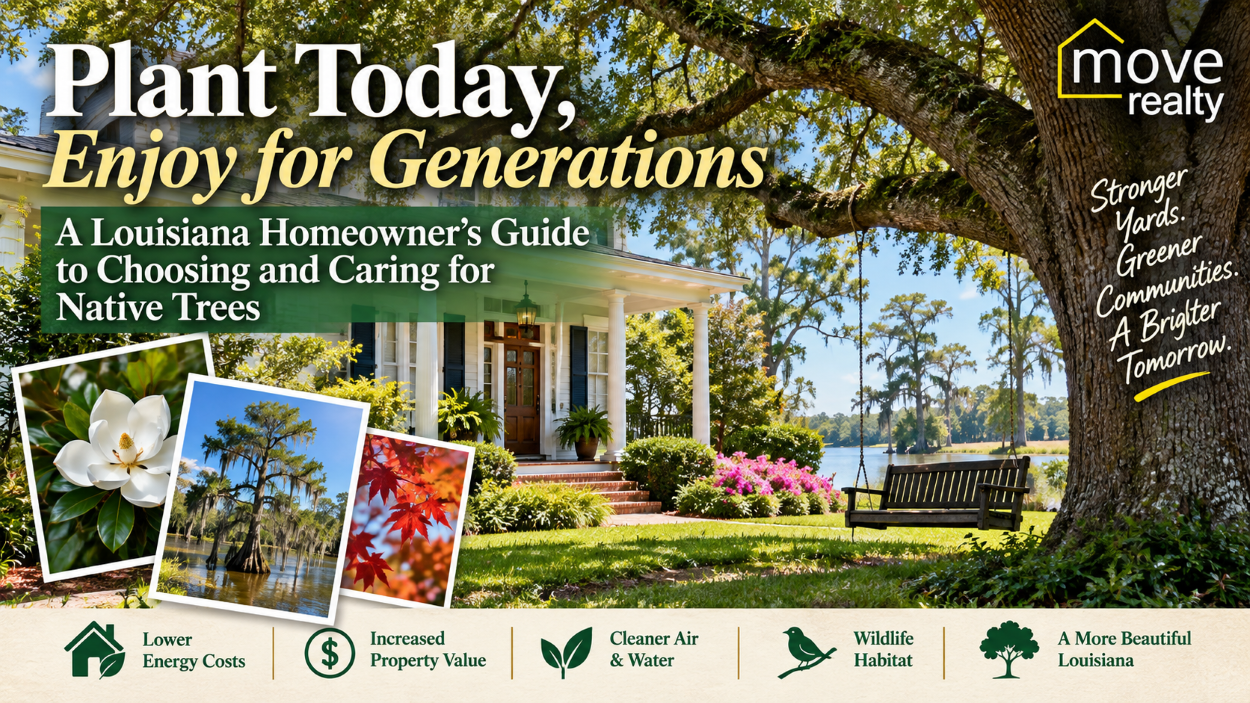
Few features of a Louisiana property can make as dramatic a difference as a mature tree.
A spreading live oak can give a home the unmistakable character of South Louisiana. A baldcypress can turn a wet portion of a yard into an asset rather than a problem. A redbud or flowering dogwood can bring color to the landscape in spring, while a southern magnolia can provide greenery, shade and flowers for years to come.
But there is something important to remember:
The beautiful mature tree you admire today probably began with someone making a good decision decades ago.
Planting a tree is one of those relatively simple property improvements whose benefits can continue long after the work is finished. And in Louisiana, choosing the right tree for the right location can be especially important.
The Native Tree Growing Guide for Louisiana, published by the LSU AgCenter, offers homeowners practical guidance on selecting, planting and caring for trees suited to our climate and landscape.
Here are some of the most useful lessons Louisiana homeowners can take from it.
Most homeowners immediately think of shade and appearance when they think about trees. Those benefits are certainly important, but trees can contribute considerably more.
According to the LSU AgCenter guide, strategically placed shade trees can help reduce household energy consumption by shading roofs and walls and moderating weather effects. Trees can also improve curb appeal, slow stormwater runoff, reduce erosion, provide wildlife habitat and contribute to the overall character of a neighborhood.
For homeowners in South Louisiana, several of those benefits are especially easy to appreciate.
Shade can make an enormous difference on a hot August afternoon. Roots and vegetation can help manage rainfall and runoff. Native trees can provide habitat and food for birds and other wildlife.
And then there is something harder to put a dollar figure on:
A mature tree can give a property a sense of permanence.
Drive through some of our older Louisiana communities and notice how often the trees are part of what makes a house, street or neighborhood memorable.
One of the best pieces of advice in the LSU guide is also one of the simplest:
Plan before you plant.
That little tree in a nursery container may look perfectly suited to the empty corner beside your house. But what happens when it becomes 40, 60 or even 100 feet tall?
The guide recommends considering the tree's eventual height, crown spread and root space before choosing a location. Homeowners should also account for buildings, driveways, sidewalks, neighboring property and overhead and underground utilities.
That means looking at your yard not just as it appears today, but as it could look decades from now.
A live oak, for example, is described in the guide as reaching about 75 feet in height with a potential spread of approximately 100 feet. A baldcypress can reach around 100 feet tall, while smaller selections such as redbud, fringe tree and several hollies may remain around 25 feet or less.
That difference matters.
A large tree planted in the right location can become a spectacular property feature.
The same tree planted too close to a house, driveway, utility line or neighboring property can eventually become an expensive problem.
Tree placement can even help with energy efficiency.
The LSU guide recommends considering large deciduous trees on the south and west sides of a home. During summer, their leaves can shade roofs and walls. During winter, after those leaves fall, sunlight can reach the house and provide some warming benefit.
Evergreens planted strategically on the north side may also help block cold winter winds.
This is landscaping with a purpose.
Instead of simply asking:
“Where would this tree look good?”
consider asking:
“What do I want this tree to accomplish?”
Shade?
Privacy?
Wildlife?
Flowers?
Fall color?
Screening?
Help with a wet area?
A focal point in the landscape?
Once you know the job, selecting the tree becomes much easier.
One of the most useful portions of the LSU publication is its tree-selection guide, which compares native landscape trees by mature size, growth rate, moisture preference, benefits and possible problems.
A few familiar Louisiana choices demonstrate just how different trees can be.
Baldcypress is Louisiana's state tree and can be especially well suited to wet locations. The guide describes it as a tall deciduous conifer whose foliage changes from lime green in spring to deep rust in fall.
Live oak is one of our most recognizable native trees. Its broad branching structure and longevity can make it magnificent where there is plenty of room—but the guide specifically warns that it isn't suitable for small yards.
Red maple offers fast growth, spring flowers and outstanding fall color. The guide specifically identifies Acer rubrum var. drummondii as best for South Louisiana.
River birch is a fast-growing, moderate-sized tree recognized for its attractive peeling bark.
Southern magnolia, Louisiana's state flower, develops into a large evergreen with a spreading canopy, dense shade and attractive flowers and fruit.
For smaller spaces, homeowners have choices such as redbud, flowering dogwood, serviceberry, silverbell, fringe tree and sparkleberry, among others. The guide also categorizes trees according to characteristics such as tolerance for poor drainage, fall color, fruit, wildlife attraction and evergreen foliage.
The lesson isn't that one of these trees is universally “best.”
The best tree is the one whose characteristics match the property and the homeowner's goals.
Anyone who owns property in South Louisiana knows that drainage conditions can change dramatically from one property—or even one part of a yard—to another.
That makes moisture tolerance an important consideration.
The LSU guide identifies several trees as tolerating less-than-ideal drainage, including baldcypress, holly, red maple, river birch, persimmon, sweetgum and wax myrtle, among others.
Conversely, some trees need better-drained locations. Yellow-poplar, for example, is specifically described as unsuitable for poorly drained sites.
This is a good reminder that landscaping problems sometimes begin with choosing a plant because we like how it looks rather than asking whether it actually likes where we intend to put it.
Choosing the right tree is only half the job. Planting it correctly matters too.
One particularly useful section of the LSU guide provides step-by-step planting instructions and a diagram showing the proper relationship between the root ball, surrounding soil and finished grade.
The guide recommends loosening an area two to five times wider than the root ball and digging the center hole at least twice as wide as the root ball—but no deeper than the root ball itself. The tree should rest on solid, undisturbed soil so that it does not settle too deeply.
That's worth remembering:
Wide hole. Proper depth.
Planting too deeply can put part of the trunk below grade, potentially encouraging bark rot and creating problems for the tree.
The guide also recommends backfilling with the original soil, rather than automatically mixing fertilizer, compost or other material into the backfill. After planting, a three- to four-inch layer of mulch can help conserve moisture, moderate soil temperature and reduce competition from grass and weeds—but the mulch should be pulled back from the trunk.
In other words, avoid building the familiar “mulch volcano” around the trunk.
Here's some good news: container-grown trees can be planted throughout the year.
But the LSU guide identifies November through February as the preferred planting period for our area because it gives new roots time to become established before Louisiana's hot, dry summer conditions arrive.
That makes fall and winter an excellent time to walk around your property and think about what is missing.
Where could you use afternoon shade?
Would a tree improve the view from a window?
Could you create more privacy?
Is there a wet area where a moisture-tolerant tree might work?
Would a flowering native add seasonal interest?
Could a tree planted today become one of the property's defining features 20 years from now?
Planting day gets most of the attention, but the months and years afterward are critical.
The LSU guide explains that establishment takes roughly 12 months for every inch of trunk caliper. It recommends regular watering during establishment, particularly when rainfall is insufficient, while cautioning against overwatering because roots need both water and air.
It also advises against automatically pruning a newly planted tree except to remove dead, diseased, damaged, crossed or rubbing branches.
And one safety point deserves special emphasis:
Do not prune trees near power lines. The guide recommends contacting the electric utility for that work.
Real estate naturally makes us think in terms of property improvements.
New flooring may last years.
A roof may last decades.
Paint eventually needs repainting.
But plant the right tree in the right place and care for it properly, and that improvement may still be there long after many other parts of the property have been replaced.
There is something uniquely Louisiana about that.
Somewhere decades ago, somebody planted many of the live oaks, magnolias, cypress and pecans that today make our homes, farms, roads and communities feel like home.
They didn't plant mature trees.
They planted small trees—and gave them time.
So whether you're improving a home you plan to sell in a few years or creating a landscape you hope your family will enjoy for generations, it is worth thinking beyond what the yard looks like today.
Choose carefully. Plant properly. Give it room. And imagine what it might become.
This article was prepared using information from the LSU AgCenter's Native Tree Growing Guide for Louisiana: The Selection, Planting and Care of Urban Trees. The publication was prepared by Dr. Hallie Dozier, Ricky Kilpatrick, Dr. Robert Mills and Dr. Joe White and was partially funded through the USDA Forest Service Urban and Community Forestry Program through the Louisiana Department of Agriculture and Forestry–Office of Forestry.
The LSU publication notes that its tree-selection lists are intended as general guides rather than exhaustive lists of suitable species.
This article is intended for general educational information. Site conditions vary considerably, even within South Louisiana. For questions about selecting, planting, pruning or caring for a particular tree, consult the LSU AgCenter, a qualified landscape professional or a licensed and insured arborist.
Shared by:
Randall C. (Randy) Anderson, REALTOR®/Agent
LOCAL PROFESSIONAL COMMITTED
M o v e R e a l t y , L L C
Licensed in Louisiana Agent License: #58902
2107 S. Burnside Av, Suite #3 Gonzales, LA 70737
Office: 225 644-7797 Mobile: 225 921-9777
Email: RandallAndersonREALTOR@gmail.com
Social media: Instagram; Facebook; Youtube; Linkedin
FREE Search | ALL Area Listings | ANY Time
www.ThatREALTORWithTheBeard.com
OR USE MY MLS MOBILE APP WHILE YOU ARE ON THE GO!!
Millions Mapped App = To install, simply text "randy" to 225-310-6511
My Graphic Blog: https://tinyurl.com/RcAGraphicBlog
Videos - YouTube Channel: http://bit.ly/MoveRealtyRcAVideos
Check Out: Client Testimonials
___ ___________________________________________ ___
🔑 YOUR DREAMS | OUR PASSION 🔑
___ ___________________________________________ ___


I am a REALTOR®/Agent at Move Realty, I grew up and live in Gonzales, Louisiana. I am married to Eileen (Clyde) Anderson, father to three daughters and a step-son, grandfather to five amazing....
Plant Today, Enjoy for Generations: A Louisiana Homeowner’s Guide to Choosing and Caring for Native Trees7-minute readFew features of a Louisiana property can make as dramatic a difference as
Article 7 — Should I Sell My Land Myself or Hire a Land Specialist? Land Seller Series — Article 7 of 30 7-minute readIf you own land in South Louisiana and have started
Article 6 — How Long Does It Take to Sell Land in South Louisiana? One of the first questions I hear from landowners who are thinking about selling is: “How long do you think
What Does a Home Appraisal Really Mean for a Home Seller?7-Minute readIf you're selling your home, you may spend a lot of time thinking about the asking price, showings, offers, inspections and
 The multiple listing information is provided by the Greater Baton Rouge Association of REALTORS®, Inc. multiple listing service from a copyrighted compilation of listings. The compilation of listings and each individual listing are ©2026 MLS. All Rights Reserved. The information provided is for clients' personal, non-commercial use and may not be used for any purpose other than to identify prospective properties clients may be interested in purchasing. All properties are subject to prior sale
or withdrawal.
Show More...
The multiple listing information is provided by the Greater Baton Rouge Association of REALTORS®, Inc. multiple listing service from a copyrighted compilation of listings. The compilation of listings and each individual listing are ©2026 MLS. All Rights Reserved. The information provided is for clients' personal, non-commercial use and may not be used for any purpose other than to identify prospective properties clients may be interested in purchasing. All properties are subject to prior sale
or withdrawal.
Show More...
