
Land Seller Series — Article 13What If Several People Own the Land? One of the most common complications I encounter with rural lots, acreage and large parcels isn't the land itself.

Dated: September 24 2026
Views: 7
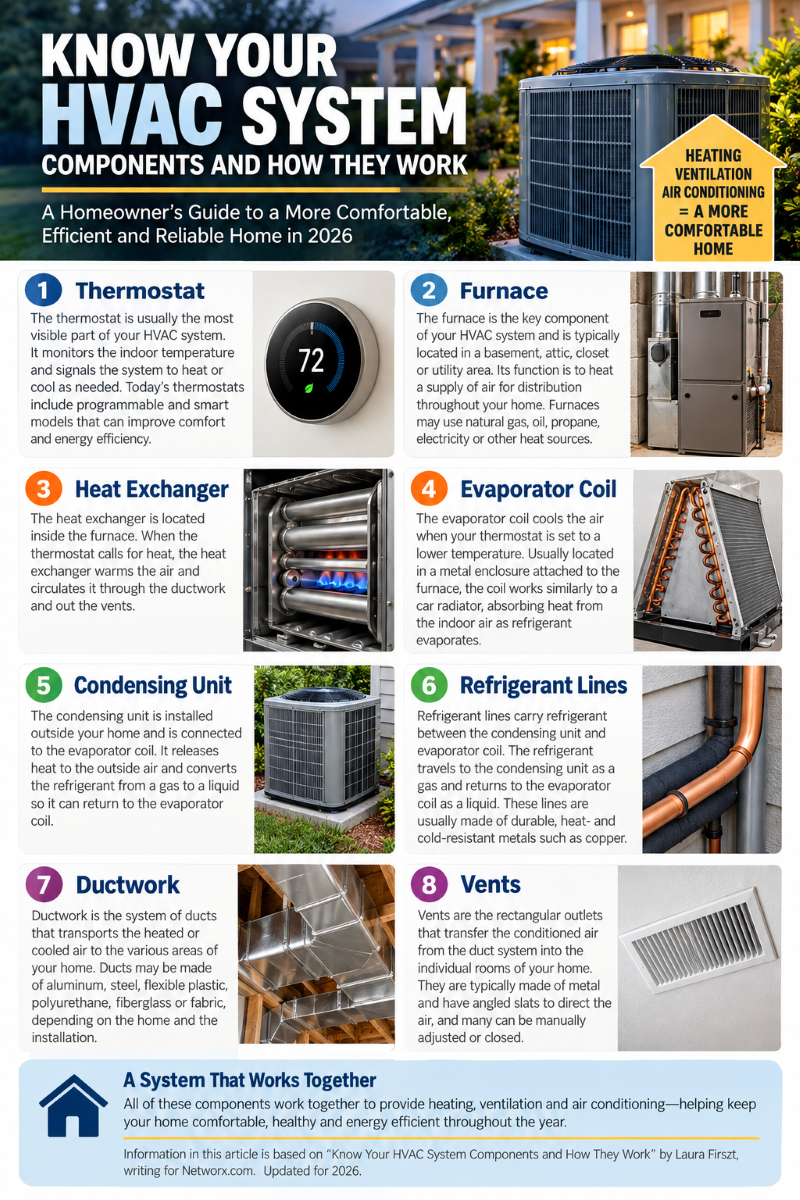
Your home's HVAC system works quietly behind the scenes almost every day. In South Louisiana, where air conditioning can feel nearly indispensable for much of the year, understanding a few basic HVAC components can help you recognize problems earlier, communicate more effectively with a service technician and make better decisions about maintenance or replacement.
HVAC stands for heating, ventilation and air conditioning. While systems vary from home to home, they generally share several basic components that work together to control indoor temperature, move conditioned air and, during cooling, help remove moisture from the indoor air.
This article updates an earlier homeowner guide, “Know Your HVAC System Components and How They Work,” by Laura Firszt, writing for Networx.com. The original identified eight major components: thermostat, furnace, heat exchanger, evaporator coil, condensing unit, refrigerant lines, ductwork and vents.
We've kept that helpful eight-part structure while updating some of the terminology and technical information for 2026.
The thermostat is the HVAC component homeowners interact with most often. It measures indoor temperature and tells the heating or cooling equipment when to operate.
The original guide described thermostats as either manually adjusted or programmable. Today, homeowners also have access to sophisticated smart thermostats that may offer scheduling, remote smartphone control, energy-use information and other features.
But regardless of how advanced it is, the thermostat performs the same essential job: it tells the HVAC system when your home needs heating or cooling.
If rooms feel unusually hot or cold, don't automatically assume the major HVAC equipment has failed. Thermostat settings, batteries, placement, programming or communication with the equipment can sometimes be part of the problem.
The original article describes the furnace as a major HVAC component responsible for heating air that is then distributed throughout the house.
A traditional forced-air furnace commonly uses natural gas, propane, oil or electricity to provide heat. The heated air is moved by a blower through the home's duct system.
However, there's an important 2026 clarification: not every central HVAC system has a furnace.
Heat pumps have become increasingly important residential heating-and-cooling systems. Rather than producing heat through combustion, an air-source heat pump moves heat between the house and outside air. It can operate in one direction for cooling and reverse operation to provide heating.
For homeowners comparing newer systems, you'll also encounter efficiency measurements such as SEER2 for cooling and HSPF2 for heat-pump heating. The U.S. Department of Energy adopted these updated testing metrics beginning in 2023, and they remain the current terminology in 2026.
If your home has a combustion furnace, the heat exchanger is one of its most important components.
The original guide explains that it is located inside the furnace and is involved in warming the air that ultimately travels through the duct system.
More precisely, combustion heats the metal heat exchanger. Air moving across its exterior picks up that heat without mixing directly with the furnace's combustion gases. The blower then moves the warmed air through the ductwork and into the home.
That separation is important for safety.
A damaged or cracked heat exchanger can potentially allow combustion gases—including carbon monoxide—to enter areas where they shouldn't. Because inspecting and diagnosing a heat exchanger requires professional knowledge and equipment, suspected problems should be handled by a qualified HVAC technician.
Homes with fuel-burning appliances should also have properly installed and functioning carbon-monoxide alarms.
When your air conditioner is cooling your house, the evaporator coil performs a very different job from the furnace heat exchanger.
The original article describes the evaporator coil as the component responsible for cooling air before that air is circulated through the ductwork.
Here's a more precise explanation.
Cold refrigerant flows through the evaporator coil. Warm indoor air passes across it, and the refrigerant absorbs heat from the air. As that happens, the refrigerant evaporates, changing from liquid toward vapor.
There's another benefit that is particularly important in our humid South Louisiana climate:
The evaporator coil also helps remove moisture from indoor air.
As warm, humid air crosses the cold coil, water vapor can condense on the coil. That moisture collects and is carried away through the condensate drainage system.
That's one reason proper air-conditioning operation affects not only temperature but also how comfortable your home feels.
This is the large cabinet you normally see outside the house.
The original source calls it the condensing unit and correctly connects its operation with the indoor evaporator coil and refrigerant circuit.
Inside the outdoor unit are components that typically include a compressor, condenser coil and fan.
During air-conditioning operation, refrigerant carrying heat from inside the house reaches the outdoor equipment. The system releases that heat into the outdoor air, and the refrigerant continues through the refrigeration cycle.
Here's an easy way to remember what your air conditioner is doing:
An air conditioner doesn't simply "make cold air." It moves heat from inside your house to the outdoors.
For that process to work efficiently, the outdoor unit needs adequate airflow. Leaves, grass clippings, vegetation and other debris shouldn't be allowed to obstruct the coil or airflow around the equipment.
The refrigerant lines connect the indoor and outdoor portions of a split HVAC system.
The original guide describes these as metal tubing that carries refrigerant between the evaporator coil and condensing unit.
Typically, you'll notice two lines. One is larger and usually insulated; the other is smaller.
These lines allow refrigerant to circulate continuously through the system, absorbing heat indoors and releasing it outdoors during air-conditioning operation.
This is one area where HVAC technology has changed substantially since the original article was written.
New residential air-conditioning and heat-pump equipment has been transitioning away from higher-global-warming-potential refrigerants such as R-410A toward lower-GWP alternatives. EPA identifies refrigerants including R-32 and R-454B as acceptable for residential and light-commercial air-conditioning and heat-pump applications subject to specified use conditions. These refrigerants have an A2L safety classification, meaning they are mildly flammable and require equipment and servicing practices designed for them.
That does not mean homeowners with an existing R-410A system automatically need to replace it. It does mean that refrigerant type has become an increasingly important question when purchasing new HVAC equipment or discussing major repairs.
Refrigerant work should always be left to properly qualified technicians.
Your HVAC equipment could operate perfectly and still struggle to keep your home comfortable if the ductwork isn't doing its job.
Ductwork is the network that carries conditioned air from the HVAC equipment to rooms throughout the house. The original article notes that ducts may be constructed from several materials, including metal and flexible products.
In many South Louisiana homes, ducts travel through attics or other spaces that can become extremely hot.
That makes proper sealing and insulation particularly important.
Leaky, damaged, disconnected or poorly insulated ductwork can allow conditioned air to escape before it reaches the intended rooms. Problems with duct design or airflow can also contribute to uneven temperatures—one room stays comfortable while another always seems too warm.
When evaluating HVAC performance, it's therefore important to think about the entire system, not just the air conditioner sitting outside.
Finally, we arrive at the part of the air-distribution system you see throughout the house.
The original article refers to these outlets generally as vents. More precisely, homeowners may encounter supply registers, which deliver conditioned air into rooms, and return grilles, through which air is drawn back toward the HVAC equipment.
Those two functions shouldn't be confused.
Blocking return-air pathways with furniture or other objects can interfere with airflow. Similarly, routinely closing multiple supply registers in an attempt to save energy can sometimes create pressure and airflow problems in a ducted system rather than producing the expected savings.
Good airflow is essential to good HVAC performance.
Think of the system as a continuous loop.
Your thermostat recognizes the need for heating or cooling and calls for the appropriate equipment to operate.
During cooling, refrigerant flowing through the evaporator coil absorbs heat from indoor air. The refrigerant travels through the refrigerant lines to the outdoor condensing unit, where the system releases that heat outside.
Meanwhile, the blower moves conditioned air through the ductwork and out through the supply vents or registers.
During heating, a traditional furnace uses its heat exchanger to transfer heat to the circulating indoor air. A heat-pump system accomplishes heating differently by reversing the refrigeration cycle and transferring available heat from outdoors into the home.
Different technologies—but the same basic objective:
Keep your home comfortable safely and efficiently.
You don't need to become an HVAC technician to benefit from understanding your system.
Knowing these components can make it easier to describe a problem when calling for service, recognize when something doesn't look or sound normal, understand a technician's explanation, compare replacement options and ask better questions before spending money.
For homeowners considering replacement equipment, efficiency ratings are also worth understanding. DOE now uses SEER2 and HSPF2 in current central air-conditioner and heat-pump testing and efficiency information.
And in South Louisiana, cooling performance isn't the only consideration. Humidity control, drainage, duct condition, equipment sizing and installation quality can all affect comfort.
You can help your HVAC system without opening equipment cabinets or attempting technical repairs.
Your HVAC system isn't a single machine. It's a collection of components that have to work together.
The thermostat provides the instructions. Heating equipment and the heat exchanger provide heat when applicable. The evaporator coil absorbs indoor heat during cooling. The outdoor condensing unit releases that heat. Refrigerant lines connect the indoor and outdoor equipment. Ductwork carries conditioned air through the house, and vents or registers deliver it where you live.
Understanding those basics can help you take better care of one of your home's most important—and often most expensive—mechanical systems.
This article is based on and adapted from “Know Your HVAC System Components and How They Work,” by Laura Firszt, writing for Networx.com. The original article identified and explained the eight fundamental HVAC components used as the framework for this homeowner guide.
The original material has been reorganized, substantially expanded and updated for 2026, including current information concerning heat pumps, HVAC efficiency terminology, refrigerants, airflow and modern residential systems. Current technical updates were checked against U.S. Department of Energy and U.S. Environmental Protection Agency information.
This article is provided for general homeowner education only and is not a substitute for professional HVAC inspection, diagnosis, repair, installation, safety, engineering or energy-efficiency advice. HVAC systems vary by home, manufacturer, equipment type and installation. Electrical components, combustion equipment and refrigerants can present serious safety hazards and should be serviced only by appropriately qualified professionals. Always follow the equipment manufacturer's instructions and applicable codes and regulations.
This is an article that I have distributed for years. I utilized ChatGPT to update and organize the information in the original brochure.
Shared by:
Randall C. (Randy) Anderson, REALTOR®/Agent
LOCAL PROFESSIONAL COMMITTED
M o v e R e a l t y , L L C
Licensed in Louisiana Agent License: #58902
2107 S. Burnside Av, Suite #3 Gonzales, LA 70737
Office: 225 644-7797 Mobile: 225 921-9777
Email: RandallAndersonREALTOR@gmail.com
Social media: Instagram; Facebook; Youtube; Linkedin
FREE Search | ALL Area Listings | ANY Time
www.ThatREALTORWithTheBeard.com
OR USE MY MLS MOBILE APP WHILE YOU ARE ON THE GO!!
Millions Mapped App = To install, simply text "randy" to 225-310-6511
My Graphic Blog: https://tinyurl.com/RcAGraphicBlog
Videos - YouTube Channel: http://bit.ly/MoveRealtyRcAVideos
Check Out: Client Testimonials
🔑 YOUR DREAMS | OUR PASSION 🔑

I am a REALTOR®/Agent at Move Realty, I grew up and live in Gonzales, Louisiana. I am married to Eileen (Clyde) Anderson, father to three daughters and a step-son, grandfather to five amazing....
Land Seller Series — Article 13What If Several People Own the Land? One of the most common complications I encounter with rural lots, acreage and large parcels isn't the land itself.
Know Your HVAC System:Components and How They WorkA Homeowner’s Guide to a More Comfortable, Efficient and Reliable Home in 2026 and Forward ...(8-minute article, read below the flyer)Your'
Land Seller Series — Article 12.1Do I Need a Survey Before I Sell My Land? [Yesterday, finalizing Article 12, I realized the importance of expanding on the subject of the land survey for
Don’t Lose Your Home to Foreclosure: If You’re Struggling With Your Mortgage, Start by Communicating(8-minute read)Financial difficulties can happen to almost anyone.A job loss,
 The multiple listing information is provided by the Greater Baton Rouge Association of REALTORS®, Inc. multiple listing service from a copyrighted compilation of listings. The compilation of listings and each individual listing are ©2026 MLS. All Rights Reserved. The information provided is for clients' personal, non-commercial use and may not be used for any purpose other than to identify prospective properties clients may be interested in purchasing. All properties are subject to prior sale
or withdrawal.
Show More...
The multiple listing information is provided by the Greater Baton Rouge Association of REALTORS®, Inc. multiple listing service from a copyrighted compilation of listings. The compilation of listings and each individual listing are ©2026 MLS. All Rights Reserved. The information provided is for clients' personal, non-commercial use and may not be used for any purpose other than to identify prospective properties clients may be interested in purchasing. All properties are subject to prior sale
or withdrawal.
Show More...
